High Conflict and Spiritual Attack

Photo by Moose Photos on Pexels.com

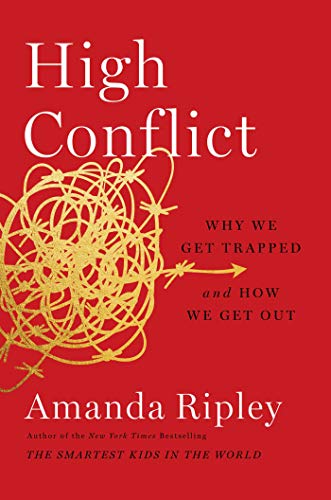
A while back, I heard a discussion on the radio about a book called “High Conflict.” As I listened, I thought, “That’s me. That’s what I’m feeling.” I put it on hold at the library, but I was way down the list. And when my turn came a few weeks ago, my heart quailed. I thought, “This is not going to be an enjoyable read.”

Then I pulled up my big girl panties and read it, praying throughout for openness. Because this, clearly, was God’s next signpost in my spiritual journey this year, toward balancing Godly anger at injustice with detachment. Because—also clearly—high conflict is NOT what God is calling me to.

Or any of us.

It was an incredible book… eye opening for myself, and extremely balanced in calling people across spectrums on the carpet. (You can tell a well balanced book by the fact that reviewers from both sides of the High Conflict that is American politics gripe about how their side was treated more harshly than the other.)

Reading that book did change me. Among the many valuable things she urged was to “muddy the waters.” The fact is that we like to put people in “us” and “them” categories, and we need to remember that we are all products of multiple influences, and just because two people share an identity in one of those influences doesn’t mean they will in others.

For myself, Catholic is my identity above all others. It is the filter through which I view everything. It is the measuring stick by which I gauge my secular work and my advocacy (“Disability Mom” and “writer” are tied for a close second in my identity)– and advocacy is, in fact, one of the red flags she warns of as an indicator of high conflict.

Anyway, the point wasn’t to detail the book, because everyone just needs to read it.

The point is that it helped me. It cooled down the temperature of my passion. Let me tell you, in the past two to three weeks, that cooling trend was critical… and not for any of the reasons I thought it would be. It’s just been a rough few weeks, personally.

And yet, yesterday I found myself triggered again. Multiple times. By multiple triggers, in multiple places. I found myself starting arguments with no one again.

The most bizarre thing was that I had a flashback to an incredibly contentious… and thankfully, defunct… relationship that caused me tremendous mental anguish over the course of COVID. I have zero contact with these people anymore. I have almost, if not completely, removed myself from these people’s orbit.

And yet, suddenly I was there in the middle of the emotions again, reliving the offenses, reliving the, well, anguish of trying to behave in a Christlike manner, cringing at the one mistake I made, raging at the certainty that they didn’t learn a thing from that conflict, that because of my mistake, they never admitted their own.

It was as if it happened yesterday instead of more than a year ago.

And sometime during Mass, as I sat behind the piano, wrenching my mind back to the liturgy again and again, it occurred to me: “I wonder if this is a spiritual attack.”

Because I WAS making progress toward what I know God is calling me to do.

I don’t have a neat and tidy bow to wrap around this post. I am just sharing the journey. Maybe high conflict, itself, is indication of a spiritual attack almost all of us are suffering…

Anyway… here’s that book you should all read, regardless of where you stand on any of the multitudes of points of contention we have all elevated to High Conflicts.
Standing on the Edge

This is on my mind today…

“I don’t want to be in a battle… but waiting on the edge of one I can’t escape is even worse.” (1:13)

Schedules being schedules, I took my oldest to the college Mass last night. Something about Mass at the very end of the day instead of the beginning–it was bedtime by the time we got home–clears the mind. I fear that what Pippin said is where we are now in the world, and it’s hard to imagine how normal life can possibly go on. Even now, it feels all off to keep living life normally, as if nothing has changed. To share concerts and plan for vacations.

I keep thinking of all those World War 2 movies, and of Rilla of Ingleside, set in World War 1. The Guernsey Literary and Potato Peel Pie Society. The Nightingale. How all those characters reacted to the unthinkable. Stories, both historical and true in spirit, which we’ve admired complacently, thinking that was all over. Thinking we could fight our proxy wars and bicker with other countries, be appalled by and donate to relieve the suffering in other countries, without being really inconvenienced by them.

Last night, the Transfiguration reading went through a very different filter between my ear and my brain. I’ve always talked about how there are these glorious moments that come right before suffering, to give you the promise of the other side, the thing to cling to as you walk through the valley of the shadow. But it feels very different today. The Cross feels different today.

I prayed last night: God, if there is a way through this, can you nudge us so we stumble onto it? And if there isn’t, please give us the grace and fortitude for what is to come.

Lord, have mercy on us.

“Outside Agitators” and Martin Luther King, Jr.

Background image by EasyGiftWizard, via Pixabay

On Martin Luther King, Jr.’s birthday, I read the Letter from a Birmingham Jail.

One of the first things that struck me was that he was writing because he had been chastised by a fellow clergyman for being an “outside agitator.” Why did this strike me so forcefully? Because I live not terribly far from Ferguson, Mo., and I heard people invoke the “outside agitator” argument myself. And at that time, I didn’t know what to make of it.

That argument goes something like this: “Those protests weren’t organized by people from ___. They were organized by national organizations who shipped people in to stir up trouble.”

I don’t think I had fully realized, until reading MLK’s letter, that “outside agitators” is how the civil rights movement works.

Martin Luther King, Jr., wrote a lengthy paragraph in the letter from the Birmingham jail, explaining this. But then he gave the quote above. Here it is, in context.

Beyond this, I am in Birmingham because injustice is here. Just as the eighth-century prophets left their little villages and carried their “thus saith the Lord” far beyond the boundaries of their hometowns; and just as the Apostle Paul left his little village of Tarsus and carried the gospel of Jesus Christ to practically every hamlet and city of the Greco-Roman world, I too am compelled to carry the gospel of freedom beyond my particular hometown.

Moreover, I am cognizant of the interrelatedness of all communities and states. I cannot sit idly by in Atlanta and not be concerned about what happens in Birmingham. Injustice anywhere is a threat to justice everywhere. We are caught in an inescapable network of mutuality, tied in a single garment of destiny. Whatever affects one directly affects all indirectly. Never again can we afford to live with the narrow, provincial “outside agitator” idea. Anyone who lives inside the United States can never be considered an outsider.
-Martin Luther King, Jr. – Letter from a Birmingham Jail

I have to admit, it was really disheartening to realize that after all this time, despite how much honor is accorded MLK across political divides, we are still using the same arguments that were used to try to shame and discredit him and his work.

The Letter from a Birmingham Jail is a breathtakingly beautiful piece which remains every bit as relevant today as it was in 1963. Well worth reading.

Archbishop Tutu on Christian’s responsibility to address racism

Photo credit: John Mathew Smith & www.celebrity-photos.com via Flickr

This quote landed in my email inbox this morning within the Center for Contemplation and Action’s daily reflection*. Archbishop Desmond Tutu’s words here affirmed the convictions that have been growing in me for the past decade and a half or so: that the political issues of our time are part of our responsibility as Christians to address.

The blatant examples of racism in the U.S. are an easy target–the way in which nationalism has become inextricably (and bafflingly!) tied to racism.

But I would argue that stopping there is the easy way out. If we make the Proud Boys et al the scapegoat, then it’s tempting to give ourselves a pass on the subtler manifestations of racism—the ones that make many of us squirm when we are forced to look at them honestly. Things like inequality of educational opportunity and funding, unevenness in the justice system from top to bottom, the generational ripple effect of redlining and discrimination in housing and the GI bill… and on and on.

The “Learning How To See” podcast episode I listened to most recently explored comfort bias—the idea that our brains reject information that makes us uncomfortable. Information that is inconvenient to us.

For sure, the idea that racism is baked into American society, and that I, as a white person, am benefiting from it, is uncomfortable! To accept that would mean that if I want to be a Christian, I am required, by my faith, to do something about it. And it might even mean working against my own worldly interests, i.e., my own comfort.

The static from certain quarters surrounding critical race theory strikes me as a perfect example of comfort bias.

Which brings us right back to Desmond Tutu, doesn’t it? What is a Christian’s response to evidence of baked-in racism? Will we lean into the discomfort and allow ourselves to be made holier by advocating for just and equitable systems in our nation? Or will we dig in to our biases and continue to “spit in the face of God”?

*The reflection carried this note about sourcing: Desmond M. Tutu, “My Credo,” in Living Philosophies: The Reflections of Some Eminent Men and Women of Our Time, ed. Clifton Fadiman (New York: Doubleday, 1990), 234, 235. Note: Minor changes made to incorporate inclusive language.

Anger, Detachment, and Love

This past Sunday, my pastor’s homily focused on the second reading, I Cor. 13, the famous explanation of love: patient, kind; bearing, believing, hoping, and enduring in all circumstances.

Along with that is the explanation of what love is NOT: quick tempered, brooding over injury. Those are the two that spoke to me personally.

Sitting there in the front row of church, it occurred to me that this was my next signpost from God about detachment vs. Godly anger. Anger tempered by love—the kind of love described in this passage–is a very different thing from plain old garden variety anger. You express it differently. In a healthier way.

So that is my food for reflection as I go through these days where the news cycle continues to provide daily reason for anger. How do I express that anger through a lens of patience and kindness, believing that there is hope?

Extra note: my youngest sister sent me a book a while back called “A Woman’s Guide to Claiming Space.” Not a religious book AT ALL, and the language sometimes reflects it. But one of the many things she wrote that struck me was the distinction between “nice” and “kind.” We often confuse the two, but nice, she argues, is what we’re conditioned to be—don’t make waves, never make anyone uncomfortable, stuff our own resentments, etc. Whereas “kind” is more authentic. You don’t have to be a jerk to tell the truth, is what it amounts to. I believe reading this book and having this reading come up in short order afterward is a God moment.

Remembering the MLK memorial on MLK day

“Out of the Mountain of Despair, a Stone of Hope”

A few years ago, we went to Washington, D.C. We took the kids out of school for a week. We toured the Capitol, saw the Declaration and Thomas Jefferson’s library. We liked the Smithsonian. We couldn’t get into the African American museum, which was new, or the Holocaust museum. We had great food. We walked the national mall at night. My husband & oldest child ran on the National Mall like Captain America. We saw the Tomb of Christ exhibit at National Geographic, and explored the Spy Museum.

But I was deeply underwhelmed by the things I expected to find the most stirring. In fact, as we looked at the Washington and Lincoln memorials, I found myself more jaded than moved. They were overrun, and all I could see was the sinful division in our country rendering impotent everything we believe in.

Our last morning in D.C. was gray and drizzly and cold. We had a noon flight. We packed up and, on the way to the airport, parked along the Tidal Basin to walk from the Jefferson Memorial to the FDR to the MLK.

That morning, at last, I felt the swelling of patriotism. I’m sure, in part, I was reacting to the solitude, since the memorials were deserted. But I also think it was because in those memorials, I recognized the proper relationship between God and country. I saw how country can reflect Godly ideals—of making God’s will for humanity known: in justice, in care for each other.

I once read an opinion piece in which someone said that many who lionize Martin Luther King, Jr. would be very uncomfortable if they actually read all his words. It took a long time to understood that, which is why it’s stuck with me. But I realize now: it’s easy to get on board with “I have a dream,” because “I have a dream” doesn’t ask us to leave our comfort zone. But when you start dissecting the practicalities of what is required to transform from dream to reality, it’s a lot more threatening.

Enough from me. I want to share Martin Luther King’s Letter from a Birmingham Jail, which is my reading project for today, in honor of Rev. Dr. King. Will you join me?

How To Detach

I set myself the task of cultivating detachment this year, but the problem is I don’t know how to start.

Last year, I had some path markers to follow through contemplation—people who had a tried & true method I could tap into. Incidentally, centering prayer will be with me the rest of my life. In fact, I’m pretty sure it’s a foundational skill for detachment.

But I don’t have that well-trodden path to follow in cultivating detachment. So the other day I just said a prayer, asking God to put sign posts in my pathway.

God does not disappoint.

Here are several things that have spontaneously crossed my online feeds in recent days. Things I have done nothing to seek out. Maybe they will give you food for thought as they have given me:

#1. a blog post

If you can’t take in anymore, there’s a reason: it’s all too much. What I took from this blog post: Social media, news, everything that’s wrong in the world is important, but we were only built to withstand so much of it. (Language alert.)

#2. … same message.

#3: not a religious article, just a summary of some research that supports the effort.

How To Be Ambivalent. The attitude they are calling ambivalence sounds a lot like what I am seeking: a degree of emotional distance from difficult realities. If it doesn’t matter so much to you, you’re more likely to be able to approach it objectively. That isn’t what they claim to be advocating for, but that’s how it reads to me.

#4: Pope Francis never disappoints, either. I get these “Journey with the Pope” emails every day, I suspect because I donated to Missio.


Complexity and Confidence

Photo by Rahul Pandit on Pexels.com

Our brains prefer a simple lie to a complex truth.
Our brains prefer a confident lie to a hesitant truth.

These are two of the biases explored in the “Learning How To See” podcast. Everything I heard on the first season was like an earthquake in my heart, but these two line up so thoroughly with my own experience, it reaches a whole other plane.

There are so many times when my kids ask a faith question, and I can think of a glib answer that will take three seconds and wholly misrepresent the complexity and the gravity of the issue at hand. But to do so would be to ignore the reality of the situation. More to the point, it would ignore the dignity of the soul that’s seeking authentic truth. Truth that stands up to their lived reality, which is, let’s face it, complex. Because it’s a complex world.

So I reply with complexity and hesitancy. I pause–to choose my words, to pray and think.

Believe it or not, this is me on Intentional Catholic, too. I know I come across loud and opinionated, and I am. But a lot of thought and inner wrestling goes into these posts. A lot of care for how the things I say will feel when read by different people.

Complexity bias, confidence bias. These two have played out so many times in the years I’ve been involved in discussions (and arguments) online. Through blogging, too. One memorable time, I waded into current events with unshakable certainty and ended up with egg on my face. It taught me to value caution and deliberation. Research before reacting. Well. Reacting in words, at least. Reacting in my heart is a whole different matter. I spend a lot of time talking myself down from initial reactions. But the point is, I do it.

The absolute confidence with which some people of faith respond to complex situations, erasing all complexities and nuance, waters down the Gospel. If people feel that the Gospel can’t address complexity, of course they’re going to dismiss it. It doesn’t help them process their own experiences. That’s not a weakness in the Gospel. It’s a weakness in those of us trying to spread it.

It is in our nature to prefer the simple lie, told confidently (stolen elections, anyone?), but I pray that we can all learn to recognize how much damage it does to be satisfied to wallow in the blindness of those biases.

(And if it’s at all unclear, that prayer is for myself, too.)

The problem with Christmas is not “happy holidays”

I don’t know if it’s because I’ve scrubbed my social media feeds or if the ruckus really has died down, but this year I’m not seeing as much about the so-called “war on Christmas.”

I did see one thing, though, as part of a different conversation with someone I love. It was a forward of an email from the Catholic League, which began by condemning that disgusting gun Christmas card Twitter photo from someone who has power in America. I’ll give no more details than that, because that person deserves no amplification.

So the email started in the right place. But it went on to decry the “dumbing down” of Christmas. The corruption of Christmas is, indeed, a huge problem. But the author got the source all wrong. His highlighted example was Christmas cards that don’t say Merry Christmas.

Really???????

Isn’t the ACTUAL problem with Christmas that capitalism has erased Christ and turned it into a moneymaking scheme??????

Hence my illustration this morning.

This is one week’s worth of trash and two weeks’ worth of recycling for a family of six in the holiday shopping season.

Dragging it all outside, I thought, “And Christian culture thinks ‘happy holidays’ is the problem??????”

It feels hypocritical to write this out. The majority of those efficiently-nested boxes are there because we ordered them. The second trash bag is full of styrofoam packing. Normally we only put out 2/3 of a bag of trash a week. (I have no idea how so many households of two and three people put out 3, 4, or 5 bags of trash a week. Where is it all coming from? Even when we were in diapers we didn’t fill a bag a week.)

I don’t like that I’m caught in this consumeristic view of the holiday. Of course, I love giving gifts to my children—as any good parent does. What brings joy to our children brings joy to us.

But it seems so odd to me that when we as Catholics are in the season of Advent, a time ostensibly devoted to simplifying our lives and letting “every heart prepare him room,” what we’re actually doing is piling on more, more, more. Cluttering things up. Both physically and mentally.

Come to think of it, I’ll bet there’s a clear reason Christian culture is so desperate to find a scapegoat that they’ll chase after Christmas cards that don’t say “Merry Christmas”:

Otherwise, we’d have to admit that everything that’s wrong with Christmas, we did to it ourselves.

Open My Eyes…

I launched Intentional Catholic with the story of how the birth of my daughter, who has Down syndrome, turned my world upside down and made me see the relationship between faith and the real world in a whole new light.

You need a little upheaval every once in a while in your life to show you where your blind spots are. Celiac disease is doing this to me all over again.

In the past three(ish) weeks, I’ve realized how little attention I have spared for people with dietary restrictions. To be perfectly blunt, I’ve never taken it very seriously. I mean, I get the peanut thing. The shellfish thing. But a lot of other things I’ve regarded with a certain skepticism.

Of course, if someone has a dietary restriction I will accommodate it. But usually with some inner sense of, “I’ll do this to be courteous, but I’m not entirely convinced this is really a thing.”

Putting that in words makes me cringe, now that I’m on the other side of it.

It never occurred to me—despite hearing about it for years–how thoughtless we are about food. Everything’s got corn in it. In our case, everything’s got gluten in it: Chicken broth. Soy sauce. Taco seasoning. Breakfast sausage. (MEAT? REALLY?!?!?!?!?!)

The insistence of the Church—it’s in canon law, even!–about having to have gluten in Eucharistic hosts is just one more indication of how completely blind we are to anything that lies outside our western European culture blinders.

People with food allergies have a really sucky situation in our world, because we’ve developed a food culture that’s inflexible, crawling with cross-contamination and people like me three weeks ago, who shrug their shoulders and say, “Well, if you can’t have gluten, just don’t eat it, even if that means 98% of the food we have at this gathering is off limits. Here’s your ONE gluten-free option.” It’s a level of self-absorption I didn’t think myself capable of anymore, and learning what it feels like on the other side has been another bruising collision with the mirror.

I met a woman this weekend who was telling me that someone in her professional realm has been asked for years to bring her own food to parties, because they weren’t willing to provide gluten-free accommodation themselves. And now that they’re feeling ashamed of themselves for that level of un-hospitality, and are trying to do something about it, they’re discovering just how incredibility difficult it is to accommodate.

I have been listening to a podcast lately called “Why Can’t We See?” It’s an ecumenical trio of contemplative Christian pastors (one of them is Fr. Richard Rohr) who are exploring the biases that prevent all of us from seeing as God sees. I guarantee you will hear more about this podcast… it’s INCREDIBLE… but for now I want to draw out one of those biases: CONTACT bias. In other words, we don’t give credence to issues unless we get to know people who are impacted by them. We dismiss their pain until we love someone who fits whatever label we’re talking about. (Muslim. Democrat/Republican. Black. Gay. Disabled. You get the idea.)

One we do love a person in a label like that, it changes how we view the issues.

The truth of this bias is VERY clear to me in this holiday time, as our family is learning to navigate celiac disease for my daughter. I care about this issue now, when a few months ago, I wouldn’t have wasted a moment thinking about it, let alone doing anything.

There’s an action item in there. For me, for you. For all of us. It should be a wakeup call that Christian hospitality is way, way bigger than we have ever allowed it to be, and the prayer to open our eyes is not a metaphysical one, but a real, practical, rubber-to-the-road one.