As promised, I’m writing one last post here to link you to the new home of Intentional Catholic. Please click through to Substack and subscribe there. My welcome post there is the reflection I wrote when I started this journey four years ago, but I have a bunch of new topics lined up, and will be mixing in some past reflections as well.
Moving the party
A heads up to everyone who reads here: I am moving this party to Substack beginning Monday morning. Those of you who are subscribed by email will receive a newsletter/post this weekend, which will be a repeat of the post I wrote four years ago to start this project.
If you are NOT subscribed by email, but through WordPress, I will post once more here when everything is ready to go, in order to share the link with you. I do hope you will join me there!
Worth Listening To
I have been listening to a couple of podcasts lately– Truth Over Tribe and The Bulletin— and thought that the things I’ve been hearing there are more worth sharing than any of my own thoughts at present. (In case you’re wondering: I listen while I’m getting dressed, cooking, and driving. Because I always wondered when people have time for things like podcasts.)
Truth Over Tribe aims to challenge both the political left and the right on topics surrounding Christianity, and they really do. This one on Christian nationalism was particularly good because it was a sober and balanced, Christ-first take. The same for the episode on “should Christians be culture warriors?” Balanced, Christ-first; rather than advocating one or the other, on this issue they land in the ambiguity of “yes.” And the one on transgender issues was interesting and challenging.
The Bulletin comes from Christianity Today and is more a commentary on current events. I haven’t yet decided if I’m going to stick with that one long term, because I’m not yet sure how useful it is to my spiritual journey. But they ran an interview with Bono, of U2, which I am finding really beautiful and want to share.
When your mind gets blown open, it can be hard to put into words
I have had my mind blown in the past few months by a podcast from the Center for Action and Contemplation. I’m not normally a podcast person, but the premise was so compelling, I had to make time for it. It’s called “Learning How To See.”
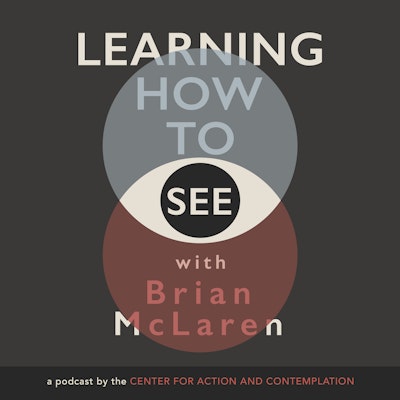
Ever since I listened to episode 1— “Why can’t we see?”—I have been wanting to blog about it. But I haven’t known what to say. Why summarize it when I’d rather you listen for yourselves? In fact, everyone in the world needs to listen to it, because it’s about all of us.
It boils down to this: a Protestant minister who is involved in the interfaith contemplative prayer movement did a deep dive into research on psychology (and maybe sociology?), because he couldn’t understand what has happened in the U. S. in the last few years.
What he found is that there are thirteen universal biases that constitute the “planks” in our own eyes that prevent us from seeing the world as it really is. Biases that cause us to cling blindly to our own view of the world, and to find another’s experience and perspective threatening.
He called in Fr. Richard Rohr as one of his companions on the first season. That’s how I encountered it—because one of my choir members loaned me Rohr’s book Just This, and I was so overwhelmed by it, I signed up for his newsletter, which led me to the podcast.
As longtime readers know, I underwent a really profound shift in world view between 2007 and, say, 2014. Most of what baffles and enrages me now is particularly “angrifying” because it’s where I came from. It’s where I used to be, not so long ago.
Listening to this podcast–with people sharing their own spiritual face plants frankly–with its prayers for openness and eyes to see as God sees, rather than as my biases would have me see—it’s like hearing my own story told through brand new stories.
It prepared me for the rude awakening that has surrounded my daughter’s celiac diagnosis. The one that showed that despite all my spiritual growth, I have plenty of blinders left.
It caused me to ask what blinders I put on to replace the ones I left behind.
I’m not sure where I’m going to go with this. I might do my own reflections on each of these biases. Maybe. But for now, I just want everyone to go listen. It’s so, so worth it.
The Now And The Not Yet
At this time of year, Catholic sites are generally be gentle and meditative, wreathed in evergreen and violet candles. (Did you see what I did there? 🙂 )
I’m not feeling that this year. Advent is normally a big thing in my household, but this year I’m giving myself a pass on some of our traditions. It’s just not where we are right now. I told my spiritual group yesterday that this year, I’m writing a book and learning how to live with a celiac diagnosis for my child, and that’s quite enough mental/spiritual wrestling for me this Advent.
But what I AM doing this Advent is pondering the tension that is intrinsic to life in the faith.
The kingdom of God is now, here, in the person of Jesus, but also unfolding in real time, and never to be fully realized in this world.
We are to accept authority—but at the same time, questioning and wrestling is the only way we grow in faith. Without it, we stagnate. Even fester, growing ever more rigid in our binary, simplistic view of the world. Kind of like all those pirates on Davy Jones’ ship in Pirates of the Caribbean—ever more inflexible, until eventually we freeze solid and lose our humanity altogether. In other words, we are called to submit, but also to be prophetic.
We are given, by virtue of our baptism, the power to heal—this is a conversation we had yesterday in my small faith group—and yet I would argue that the chronic conditions of my life are the things that have allowed me to grow.
I think there’s a lesson in all this for me as I begin this discernment surrounding detachment. Because that is the essential question I can’t wrap my brain around—the one I shared here a couple of weeks ago. Godly anger is what fuels us to pursue Godly justice. Yet this seems to stand at odds with the idea of detachment, which would suggest that we remain a step back emotionally, setting aside such passions altogether.
That’s why this graphic caught my attention when it crossed my feed last week. It’s not about religion, but my faith is integral to my view of the world, and that gets expressed through real-world events, i.e. the news. So it resonated on the level of faith for me.

In my last appointment, my counselor and I were grappling with balance, and she said, “I just want to make sure you know that balance means it’s always changing. It’s not the same from day to day.”
She was right, of course; I’ve known this for a long time in my family life—that one or another of my responsibilities takes precedence at any given time, and it’s constantly shifting. We tend to think of balance as a static thing: a beam BALANCED on a point. But that only works if all the factors acting on it are static. As the forces of my life act upon me, I have to adjust constantly. I do it automatically on a bicycle. Or walking. Or when a small child runs and tackles me while I’m sitting in the middle of the floor.
But somehow when it comes to the bigger things, the spiritual life, I have this fantasy that there’s some magical island within me that if I can just find it, I’ll never have to adjust again.
But the reality of the “now-and-not-yet” dynamic is that those two things DO stand at odds. That tension will never be resolved in this life. On one side is the passion to see God’s justice made real in the world: “Thy will be done, they kingdom come on earth as it is in Heaven.” We pray for that daily. God’s will for the earth can’t happen if we shrug our shoulders and say, “Oh well, in Heaven all will be well, so I just won’t worry about everything that’s wrong.”
At the same time, the righteous anger that fuels the passion can easily become unhealthy. Crippling. Damaging to the connection to God and neighbor. Detachment is necessary too.
There’s a tension there that can’t be avoided. Neither of the extremes contains the whole truth. The truth comes in the balance between them.
But finding it… that’s the thing I’m beginning to grapple with now.
Persist and Pester
On October 16th, Pope Francis addressed the fourth World Meeting of Popular Movements, which evidently made a splash because he called out the same people, institutions and problems he always calls out. Before he launches into his list of “In the name of God, I ask…” he talked about how he sometimes feels like a pest for repeating the same talking points again and again. I had to smile when he returned to it at the end.
That is exactly how I feel often pretty much always sometimes.
God, bless Pope Francis. May he have the strength to keep pestering us until we listen.
God has a way, even if I can’t see it
My first spiritual reading for 2021 is William A. Meninger’s The Loving Search for God.
This book consists of bite sized reflections on contemplative prayer. For the past half dozen chapters, he has been reflecting on Jesus reciting Ps. 22 on the cross. Grappling with the collision of despair and trust in God contained in that psalm.
How do these two conflicting realities coexist? Meninger points to 12-step programs. People often have to hit bottom before they can start going up. And when you’re in that “bottom,” like Jesus on the cross, your faith in God’s salvation has no form. It’s just trust that God has a way through this muckfest, even if you can’t see what it is.
“Misery was so great he was not able even to imagine what that salvation would consist in,” Meninger says.
When I read these words, I literally caught my breath for a moment. Because that is precisely what I’ve been feeling for the past few months, as the world seems to burn around me. Where is salvation in this situation? Where is the way forward, when anger and division are so great that we can’t even agree on what constitutes “truth” and “lie”?
And oddly (or perhaps not so oddly), there is comfort in knowing that this is when God really shows power through our weakness. Because God can make a way where there isn’t one. There’s comfort in the reassurance that God can use the worst failures of humanity to awaken the collective conscience and bring us, well… closer, anyway, to on track.
Come, Lord Jesus.
A new word for the year
Every year around mid-December, I begin praying over what God wants me to focus on as a spiritual goal for the new year. This year, more than ever before, I was aware that the word cloud of “words of the year” from the last several years all point in a single direction; they are different facets of a single reality I continue to struggle with.
Discovering enneagrams last year shed a lot of light on myself. To be a #1—a crusader—is by definition to be dissatisfied, to be always striving, and always focused on what stands in need of betterment.
I thought, first, “Maybe it’s time to cycle back through the last several years’ words.”
Then I thought, “Maybe it’s time to turn my attention elsewhere. Maybe ‘love’ would be an appropriate new focus.
But then my husband took my hand when we got in bed the other night and said, “Are you happy with your life?”
And as I looked inward I saw the restless discontent inside, and I knew my first instinct had been the right one.
Only it turns out there’s another facet to explore, another way to approach this long-standing spiritual goal of mine, and so that’s where I will focus this year: #contentment.
Do you set yourself a focus for each year? If so, share here so we can pray for each other!
Be Still
I am overwhelmed with busy work right now and as I was praying this morning, I came to the realization that something has to give right now. Killing myself to write posts about how to be faithful and enter into Advent is kind of silly. So I will “show” instead of “tell,” as we say in fiction world, and take one thing off my plate for the duration of Advent. See you after the first of the year.

Fear and Faith, Part 1
An exchange earlier this week on Instagram got me thinking about the relationship between fear and faith. Over the years I’ve pondered this quite a bit, so rather than try to write it again, it makes more sense simply to re-share things I’ve written before on the topic.
The first reflection was originally written in August of 2011.

My freshman year of high school, a non-denominational organization called Youth For Christ rocketed into prominence. I thought that meant it was for all Christians, and indeed, it seemed to cross boundaries. The most popular kids in school and plenty of the invisible majority walked the hallways wearing snappy black T shirts that proclaimed, “Jesus loves U2. Jesus: if you still haven’t found what you’re looking for.”
One night they brought in a high-powered speaker. They filled up a large room with teenagers: in folding chairs, standing at the edges and the back. I don’t remember much about the talk itself, except that it scared me. It was about “almosters,” people who are almost good enough for Heaven, but not quite, and who thus will burn in fiery damnation for all eternity.
I started thinking of my faults, of the sacrament of Reconciliation, and what would happen if I forgot to confess something. I got more and more scared…but alongside the terror grew another, quieter sense of discomfort, one I couldn’t put words to.
Then came The Altar Call. You know: “If you want to profess Jesus Christ as your personal Lord and savior, get up and go to the back, where we have people waiting to speak with you.” And suddenly, the shuffling chairs, the whispers and sniffles and scraping sneakers all around me, made me realize something that cut the legs from beneath the fear.
We were being manipulated. Manipulated, in the name of religion.
That moment of clarity changed everything. I sat in my hard folding chair with my eyes closed, my arms folded, and prayed. Prayed that I wasn’t imposing my will on God’s. That if this was truly from God, that I would be open to it, even if it felt wrong. I kept praying as the speaker backed off his altar call: if you feel like you want to make the profession, but you need help to do it…if you feel moved, but need more information…if you simply want to ask questions…
At this point, I felt a stab of disgust. I realized he wasn’t going to be satisfied until the room was empty, until every person had gone to get “saved.” And I knew, with absolute certainty, that this wasn’t how God worked.
I sneaked a peek. The holdouts were me and one other girl—also Catholic. At this last, shameless call, she gave in.
I did not.
When it was all over, the last holdout and I went to the leaders to express our displeasure with how non-inclusive this experience was, and asked if we could bring in somebody to offer another perspective on being not quite good enough for Heaven. Oh, no, they said, we’re not going to get into doctrines of individual denominations. That’s how you tear groups like this apart. I hadn’t really expected a Protestant to buy in to the idea of Purgatory, but still, it irked. It wasn’t until hours later that I realized why: their entire presentation represented a sliver of Christianity, and not the whole.
I never went back.
It’s tempting to impose the more mature faith of my thirties on my fourteen-year-old self. Of course I didn’t have it worked out then like I do now, just as I’ll have it worked out better when I’m sixty than I do today. But I do believe that experience sensitized me to emotional manipulation in the name of God. Maybe that’s why my TEC (Teens Encounter Christ) two years later fell so flat, and made me so suspicious of retreats in general: that entire weekend felt like a giant emotional manipulation.
I know that many people have found their faith bolstered by such experiences. No doubt true conversions have happened off of altar calls employing fear tactics. God can use any circumstance to achieve His purposes.
But mostly, I think it harms Christianity. Because when you get back out into the real world, that amazing little thing called intellect kicks in, and you start to see the flaws. You realize that you’ve been manipulated. And then what? What saves a fledgling faith when it realizes it is based on manipulation?
 Intentional Catholic